





 (No Ratings Yet)
 Loading...
Fullscreen




 (No Ratings Yet)Loading...
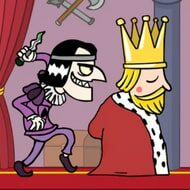
 You drag Joe’s scarecrow, tap the rooster, shake your phone out of frustration, and the puzzle still won’t budge — until you spot the one detail Brain Test 2 Tricky Stories hid in plain sight. That flash of realization, more than any single riddle, is what keeps players moving from one level to the next. It’s a sequel built less around harder logic and more around moving the logic somewhere you weren’t looking, using the screen, your device’s tilt, or a stray line of dialogue as the real clue.
| Genre | Puzzle, brain teaser |
| Story chapters | Tom, Emily, Joe, Sam, Monster Hunter |
| Levels per chapter | 20 connected levels |
Instead of one long chain of unrelated riddles, the puzzles are grouped into chapters that each follow a single character through 20 connected levels. Tom opens the game as the somewhat hapless everyman, and his chapter teaches the basic habit the rest of the game depends on: touch and drag everything before assuming a puzzle is unsolvable. Emily’s chapter shifts toward logic and chemistry-flavored setups, Joe’s revolves around animals, crops, and farm equipment, and Sam works through a haunted house, described as brave but visibly scared of what’s behind each door.
Monster Hunter, the fifth storyline, plays differently again, leaning on deception and misdirection with multi-step trapping sequences instead of a single-object solution. Players who rush through dialogue tend to miss the setup clues in each character’s opening lines, while players who read every line first usually solve the same level in fewer taps. What makes the character split work is that each personality doubles as its own hint system — a farmer’s puzzle rewards farm logic, a scientist’s puzzle rewards systematic thinking, and a hunter’s puzzle rewards patience over speed.
Brain Test 2 Tricky Stories leans hard on interactions that go beyond tapping the correct object, and recognizing which one a level wants is half the challenge.
Dragging and repositioning: most levels expect objects to be physically moved rather than tapped once, and the solution often depends on where an item ends up, not just that it was touched.
Shaking the device: certain levels only progress once the phone or tablet is shaken, usually tied to a story beat like knocking something loose or waking a character up.
Tilting and brightness: a handful of puzzles respond to tilting the screen or adjusting the device’s brightness slider, turning a setting most players ignore into the actual answer.
A lightbulb icon sits in the corner of the screen for exactly the moments described above, when a level’s twist isn’t obvious from looking at it once. Hints can be earned by clearing levels without skipping ahead, or unlocked through a short ad view for players who don’t want to wait. Solving a level without opening the hint at all is its own small badge of honor in player conversation, even though nothing in the interface tracks it directly.
The difficulty curve resets at the start of every chapter rather than climbing continuously. The first level of Joe’s farm chapter is noticeably gentler than the twentieth level of Emily’s chapter right before it, which catches players off guard if they expect a steady ramp. Solutions in later levels of a chapter also start referencing earlier levels in that same chapter, so remembering a trick from level six can matter again by level eighteen.
Brain Test 2 Tricky Stories still relies on the same trick that made Tom’s opening levels work: assume nothing about the object on screen until you’ve dragged it, shaken it, or looked at it from Monster Hunter’s more suspicious angle. That habit carries a player from the barnyard through the haunted house without a walkthrough for every level.





There are no reviews yet. Be the first one to write one.