




 (No Ratings Yet)
 Loading...
Fullscreen




 (No Ratings Yet)Loading...
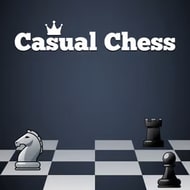
 You slide a bishop into a clean diagonal shot, tap it, and the hint arrow curls off toward a rook move you hadn’t considered. Casual Chess keeps doing this – showing you the position you thought you understood, then quietly pointing at the line you missed.
Underneath the click-to-move interface is a full chess ruleset, playable against a computer opponent or a second person sharing the same screen. Three board themes change how pieces and squares read at a glance, and three difficulty settings decide how sharply the computer punishes a loose pawn structure. None of that matters if a player doesn’t know what the board is telling them.
| Genre | Board / Strategy |
| Difficulty Settings | Three tiers |
| Modes | Versus computer, versus a second player |
| Extras | Three board themes, move hints |
The lowest tier lets a lot slide. The computer will develop a piece into an exposed square, forget to defend a pawn it just pushed, or trade down into a position it didn’t need to enter. That looseness gives a new player room to practice spotting a hanging piece without instant punishment.
The middle tier tightens that up. Pieces left undefended for more than a move or two get taken, and the computer starts calculating short combinations rather than just reacting. Players who liked the easy tier’s pace often find this jump the first real wall in Casual Chess.
The top tier defends accurately and looks for tactics rather than waiting for them. Jumping straight to it without opening structure usually ends the same way – a quick, avoidable checkmate because the king never got safe. Players hunting a genuine test gravitate here once the basics stop needing thought.
The hint system suggests one move by drawing an arrow across the board. Early on it’s a shortcut around calculating a line; by the third or fourth match most players use it to check their own read of a position instead, the more useful habit.
A short list of habits holds up in nearly every game:
Chess purists sometimes gripe that the arrow removes the discovery of calculating a line yourself, and that criticism has teeth. Used sparingly, though, it functions closer to a second opinion than an answer key.
A fork happens when one piece, usually a knight, attacks two enemy pieces at once with no way to save both. It’s the single most common tactic deciding a middlegame on the medium and hard tiers, since the computer will leave a knight fork on the board if a king and queen aren’t tucked away safely.
A pin is the mirror case: a piece can’t move without exposing something more valuable behind it, often the king. Recognizing a pin early lets a player pile on pressure, since it can’t escape without breaking the rule that keeps its king safe.
Castling and en passant are both live rules in Casual Chess. Castling early protects the king before the center opens; en passant only applies right after an opponent’s pawn advances two squares past your own, and missing that window means the capture is gone for the match.
The lowest of the three tiers is the right start for anyone still learning how pieces move and interact, since the computer forgives loose play that gets punished immediately on the higher settings. Move up once checkmate patterns and piece values feel automatic.
Yes, both standard rules are active. Castling works on either side once the squares between king and rook are empty and neither piece has moved, and en passant is available for exactly one move after the triggering pawn advance.
Checkmate ends the match the moment a king is under attack with no legal escape, block, or capture available. Stalemate produces a draw instead – the player to move has no legal move at all but their king isn’t in check, which catches someone off guard while pushing for a win with a big material lead.
Casual Chess isn’t trying to be a training tool with evaluation bars and engine commentary – it’s a board, three themes, three difficulty rungs, and a hint arrow that occasionally finds the en passant capture a player overlooked. Once castling timing and the knight fork stop requiring conscious effort, the hardest tier turns from a wall into the actual game.



There are no reviews yet. Be the first one to write one.