





 (1 votes, average: 5.00 out of 5)
 Loading...
Fullscreen





 (1 votes, average: 5.00 out of 5)Loading...
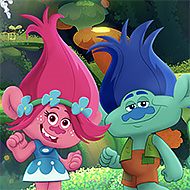
In Trolls Game: The Beat Goes On! you start with three lilac blossoms protecting your run, and that number matters the second the first mushroom trap or vine snags Poppy’s feet. This is a lane-runner built around music recovery — Poppy moves forward on her own, and your only job is timing her jumps so she survives long enough to gather every note scattered across the forest.
| Genre | Musical lane-runner |
| Main character | Poppy |
| Core objective | Collect musical notes, avoid obstacles |
| Structure | Three troll-forest stages |
| Lives system | Three flowers, regained via lilac blossoms |
The game never asks you to steer left or right in the traditional endless-runner sense. Poppy sprints through Troll Village and its surrounding forests automatically, gaining speed as the run continues, and your input is limited to a single tap or click that makes her jump. That simplicity is deceptive — timing gets tighter as the pace increases, and a jump thrown a half-beat early lands you right back on the ground in front of the next obstacle instead of clearing it.
New players tend to jump reactively, tapping the moment they see danger rather than reading the rhythm of the terrain ahead. Players who treat the game more like a rhythm title than a pure reflex runner usually last longer, because the obstacle spacing tends to follow the beat of the background music rather than appearing at random.
Casual players who just want to hear the soundtrack and watch Poppy dance through the scenery tend to stop caring about high scores fairly quickly, and that’s a valid way to play this one.
Notes are the entire point of the run. Every note collected pushes Poppy closer to finishing the “perfect song” the trolls need for their daily celebration, and skipping notes to play it safe defeats the purpose of the game even if it technically keeps your flowers intact longer. Lilac blossoms scattered along the path are the recovery mechanic — collecting one restores a flower if you’ve lost one, which means a rough early stretch can be undone if you keep pushing forward instead of playing overly cautious.
Score-chasers who care about leaderboard position treat every lilac blossom as mandatory, since a full flower count late in a stage is often the difference between finishing and losing a life to one careless hit on a big mushroom or trap. Losing all three flowers ends the run immediately, so the balance between chasing notes and detouring for blossoms becomes the actual skill ceiling of Trolls Game: The Beat Goes On!, not raw reflexes.
The run is split into three distinct forest stages, and each one raises the density of traps and big mushrooms rather than simply speeding up the same layout. By the time you reach the third forest, obstacles start appearing in tighter clusters, and a single missed jump there is far more costly than the same mistake early on, since there’s less recovery room before the next hazard.
Speedrun-minded players tend to memorize the obstacle rhythm of each forest rather than reacting live, which is the only way most people consistently finish all three stages without burning through their flowers. That kind of route memorization is common vocabulary in the comments sections around this game — players talk about “reading the forest” the way rhythm-game fans talk about reading a chart.
Beyond a single run, the game tracks daily quests tied to note totals, which gives completionist players a reason to replay stages they’ve already cleared instead of stopping once they’ve finished the three forests once. It’s a light structure, but it’s enough to keep the game from feeling like a one-and-done experience.
One detail players consistently mention is how the music genuinely shifts in intensity as you clear more notes, rather than looping flatly in the background — it’s a small touch, but it’s the kind of thing that only becomes obvious once you’ve actually played through a full stage rather than watched a clip of it.
Trolls Game: The Beat Goes On! works because it doesn’t overcomplicate the runner formula — Poppy’s automatic sprint, the lilac blossoms that forgive your mistakes, and the three forests that slowly turn a relaxed jog into a genuine test of timing all add up to something more replayable than its simple controls suggest.




There are no reviews yet. Be the first one to write one.