



 (No Ratings Yet)
 Loading...
Fullscreen







 (No Ratings Yet)Loading...
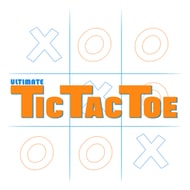
 What happens when winning a small board in the corner sends your opponent straight into the one board you were hoping to keep for yourself? That question is basically the whole appeal of Ultimate Tic Tac Toe, and it’s the moment new players realize the game isn’t the time-killer its name suggests.
The board is nine ordinary tic-tac-toe boards arranged inside one larger 3-by-3 grid. Players call the small boards local boards and the larger grid the global board, and a win on the global board only happens by claiming three local boards in a row, not by winning a single game inside a single square.
The first player can open anywhere across all eighty-one cells, and that choice shapes everything after because of the rule governing every later move: wherever a player places their mark inside a local board, that position dictates which local board the opponent must play in next. A mark in the top-right cell of a local board sends the opponent to the local board sitting top-right on the global grid.
A lot of players open in the center square of the center board because it looks strongest. It sends the opponent straight back into the center board too, which is exactly the board most experienced players want to control. Many regulars deliberately avoid it and open in a corner instead, giving up the flashy first move for a position their opponent can’t immediately punish.
Beginners who fixate on winning whichever local board is right in front of them tend to miss this. They’ll take a board on move three or four without noticing they’ve handed their opponent an open choice of where to play, because the board they sent them to was already full or won.
If a player is sent to a local board that’s already won or filled, the rule stops applying and they choose any open board on the grid. Community players call this the wildcard move, and it’s the biggest swing moment in most matches, since it hands total control at exactly the point the forced-move rule would otherwise dictate the choice.
Two ideas explain most of the strategic depth beyond the basic rules, and neither is a step so much as a shift in how a player reads the board.
Sacrifice is deliberately losing a local board rather than fighting for it. Winning a small board matters only for the mark it leaves on the global grid, so if defending it forces a play into a board that hands the opponent a wildcard move, letting it go is often the stronger choice.
Sending is choosing a cell because of where it forces the opponent next, not because it helps win the local board it’s played in. A player can lose a board on purpose because the losing move sends the opponent into a board where every remaining line is already blocked.
The hardest adjustment for anyone used to a single tic-tac-toe board is tracking nine positions at once instead of one. Players who only look one move ahead tend to win a local board immediately when they can, without checking whether that move sends the opponent into a board that wins the whole game for them instead.
By the fourth or fifth exchange, the global board usually has two or three local boards decided, and that’s when the real match starts. Once several boards lock, the ones still open carry disproportionate weight, and a player who’s quietly set up a line across three boards can win with a move that looks unrelated to whatever just happened.
Draws are more common here than in standard tic-tac-toe and frustrate a certain kind of player – the match ends in a draw the instant no board remains open, even if the global grid still has empty cells inside boards already decided. A grid can look wide open and still be completely dead.
Near the end of a match, the wildcard move becomes more dangerous, since fewer open boards are left for it to land in. A player two boards from winning the global grid has to watch not just their own line but every cell that could send the opponent into the board that completes it for them instead.
Players chasing a fast win often stop tracking the global board’s three-in-a-row lines while focused on a single local fight, which is exactly when a patient opponent closes it out. The skill that separates strong players isn’t clever local tactics – it’s never losing track of the larger board those fights feed into.
Ultimate Tic Tac Toe rewards exactly that attention, and it’s why a game built from nine copies of something most people learned before they could read still produces real, hard-won turning points – the wildcard move that swings a stuck board back open, or the sacrifice that quietly sets up a win moves before anyone notices it coming.



There are no reviews yet. Be the first one to write one.