






 (1 votes, average: 5.00 out of 5)
 Loading...
Fullscreen













 (1 votes, average: 5.00 out of 5)Loading...
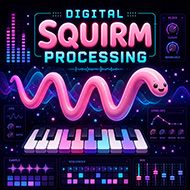
 Digital Squirm Processing looks like a cute puzzle toy at first glance, but it plays like a compact lesson in how sound actually works. The game grew out of Ludum Dare 59, a game jam built around the theme “Signal,” and that origin shows in everything from its pacing to its subject matter. Instead of dropping you into a fantasy world with named heroes and villains, Digital Squirm Processing hands you real audio waveforms and asks you to bend them into shape, and the fact that it started life as a jam entry explains why the whole game feels tightly scoped rather than sprawling.
| Genre | Puzzle / Educational |
| Platform | Browser |
| Origin | Ludum Dare 59 game jam (“Signal” theme) |
| Core Mechanic | Manipulating audio signal parameters to complete tasks |
The core loop is simple to state and harder to master: you’re given a signal, and you adjust it until it matches a target behavior. That might mean smoothing out noise, reshaping a waveform, or nudging a frequency into range. There’s no combat and no inventory — the challenge is entirely about listening and watching the waveform respond to your input, which is a different kind of tension than most browser games ask for. Where a typical arcade game measures success in reflexes, Digital Squirm Processing measures it in how precisely you can read what a wave is doing and predict what your adjustment will do to it before you commit to the move.
Because the game is teaching digital signal processing concepts under the hood, early levels tend to introduce one idea at a time — what a frequency is, what happens when you filter it, how amplitude changes what you hear. Beginners often try to solve levels by ear alone and get stuck, when the visual waveform on screen is usually giving a clearer answer than the audio does. Players who split their attention between what they hear and what they see tend to progress faster, and that habit — checking the waveform shape before trusting your ears — carries over directly into the harder stages later in the game.
The difficulty curve isn’t about speed or reflexes. It’s conceptual — later stages combine two or three signal properties at once, so a fix that worked earlier in the game can actively work against you if applied without thinking. That’s the moment most players describe as the game “clicking,” where Digital Squirm Processing stops feeling like trial and error and starts feeling like actual problem-solving. A player who enjoys methodical, one-variable-at-a-time thinking tends to find this shift satisfying rather than frustrating, since it rewards the same patience that made the earlier, simpler levels click in the first place.
There’s no cast of characters here, no map to explore — the “world” is the waveform itself, and the humor comes through in how the tasks are framed rather than through dialogue or lore. That’s a deliberate trade-off. Players looking for a game with named enemies or a plot to follow won’t find one, and that’s the one honest criticism worth naming: some players bounce off the game specifically because it’s more toy than adventure. If you go in expecting a puzzle game with a scientific backbone rather than a story-driven one, that trade-off makes a lot more sense, and once that expectation is set, the lack of narrative stops feeling like an omission and starts feeling like the point.
What keeps people around instead is the small, satisfying feedback of hearing a messy signal resolve into something clean. Players who enjoy tinkering — the kind who’d rather fiddle with an EQ than follow a quest marker — tend to get the most out of it, and so do people using it as a genuinely painless way to pick up signal processing basics without sitting through a lecture. It’s the kind of game a player might open expecting five minutes of curiosity and end up spending closer to half an hour on, simply because each solved level makes the next one feel reachable.
The jam context also matters for how forgiving the difficulty feels. Digital Squirm Processing was built within a jam’s tight timeframe, and that shows in how efficiently each level teaches its concept rather than padding it out — there’s rarely a stage that overstays its welcome, which is part of why it earned recognition among the wave of games that came out of Ludum Dare 59’s “Signal” theme.
Digital Squirm Processing rewards short, focused sessions more than long grinding ones. Because each level isolates a specific idea, replaying a stage after finishing the game once often reveals a faster or cleaner solution than the one you found the first time around. Newcomers to signal processing concepts especially benefit from this, since a level that took ten attempts on a first playthrough can often be solved in one or two once the underlying idea has settled in.
This comes up constantly for people new to the game. The trick isn’t training your ear harder — it’s trusting the on-screen waveform display, which visually separates frequencies that sound nearly identical when played back. Once players start reading the waveform first and listening second, this stops being a blocker, and most report that the skill transfers to later levels almost immediately.
It holds up reasonably well as an intro. It won’t replace a course on digital signal processing, but the game’s structure of isolating one concept per level mirrors how the topic is often taught, which is part of why it got attention as a jam game in the first place. Players coming in with zero background in audio theory tend to get more out of it than players who already know the concepts, since the game’s pacing is built for a first-time learner.
Digital Squirm Processing isn’t trying to be more than what it is: a small, focused puzzle game about sound, built around signals rather than characters or combat. If you finish it and go back to fiddle with the earlier signal-shaping levels, that’s usually the sign the game did what it set out to do.







There are no reviews yet. Be the first one to write one.