






 (No Ratings Yet)
 Loading...
Fullscreen













 (No Ratings Yet)Loading...
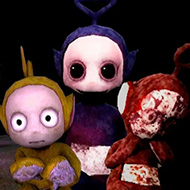
 Slendytubbies 0 Records looks, from the name alone, like it could be another official spinoff sitting inside a long-running horror franchise, but what actually loads is a fan-built take on that franchise’s core loop: three-dimensional movement through a dim environment, a handful of pages scattered across it, and one pursuer standing between you and collecting them.
Control is split across two separate inputs rather than combined into one mouse-driven scheme. WASD handles movement — forward, back, and strafing left or right — while the arrow keys independently swing the camera to look around the space. Because the two aren’t tied together the way a typical mouse-look shooter would combine them, getting oriented takes a moment the first time you load in, especially in tighter corridors where a wrong turn puts a wall directly in front of you.
Once the split control scheme clicks, it opens up a habit regular players fall into fast: walking forward with WASD while tapping the arrow keys to glance down side passages, checking for a page or for Tinky Winky before committing to a direction. That constant small adjustment is where most of a session actually happens — less running, more checking corners.
The camera doesn’t auto-center, so if you’ve been looking left for a while, forward movement keeps carrying you at that angle until you correct it manually. New players consistently misjudge this in the first couple of minutes, drifting into walls or missing a page sitting just off to one side because the camera was still pointed the wrong way from the last turn.
Pages are the only objective the build tracks. Getting close enough to one triggers the pickup with a click, and there’s no separate confirmation step or animation beyond the page disappearing from the environment once it registers. The catch is proximity: standing too far away does nothing, so every pickup means committing to open ground near wherever the page happens to be sitting.
A single page pickup generally follows the same small sequence:
Skipping the last step is the single most common way a run ends early — players collect a page and keep walking in whatever direction they were already facing instead of checking where the threat actually is, which is exactly when Tinky Winky tends to close the gap.
Tinky Winky doesn’t patrol on a fixed loop that can be memorized and outrun the same way every time; distance and direction change enough between attempts that a route learned in a previous session stops working within the first couple of pages. What stays consistent is the general shape of the threat — a single pursuer, no allies, no ranged attack, just proximity turning into a chase once it gets close enough.
Because the pursuit is proximity-based rather than scripted, the middle of a run tends to be tenser than the start. Early on, with most pages still far apart, there’s room to explore without much pressure. By the third or fourth page collected, the remaining space to search narrows, and the odds of crossing paths with Tinky Winky while backtracking climb with it.
The broader Slendytubbies franchise this build draws from has grown well beyond its original release, spanning three main installments by now along with a long tail of fan remakes built on tools ranging from full 3D engines down to block-based platforms. Slendytubbies 0 Records sits at the small end of that spectrum, built without the polish or the additional systems the bigger franchise entries carry, and it doesn’t try to disguise its scale.
That scale is also the most divisive thing about it. Movement and collision read noticeably looser than a dedicated 3D engine would produce, corners occasionally catch a character model in a way a bigger production wouldn’t allow, and the environment itself is small enough that a full pass through it doesn’t take long. None of that stops the core chase loop from working, but it’s a fair trade players notice immediately coming in with expectations set by the wider franchise.
Slendytubbies 0 Records won’t be mistaken for one of the franchise’s bigger releases, but the WASD-and-arrow-key split, the page-by-page tension, and Tinky Winky’s proximity-based pursuit give it a small, functioning loop that plays exactly as tense as it needs to.







There are no reviews yet. Be the first one to write one.