





 (No Ratings Yet)
 Loading...
Fullscreen













 (No Ratings Yet)Loading...
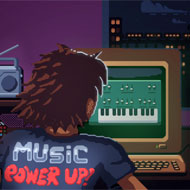
What happens when a music game stops pretending the songwriting is the hard part and just hands you a real sequencer? Music Power Up answers that by putting you in the shoes of a musician in the 1980s, tasked with scoring early video games while learning actual sound synthesis along the way. It’s less a rhythm game and more a career simulator wrapped around a genuine music studio.
| Genre | Music simulation / career sim |
| Platform | PC (Steam), mobile pre-registration |
| Setting | The early digital revolution of the 1980s |
| Core loop | Meet clients, compose soundtracks, complete playable games |
| Recognition | Nominated for IndieCade 2024, Audio Design category |
Your studio in Music Power Up starts small: a handful of tracks, a modest drum box, a synthesizer with limited presets. As you complete jobs and meet the game’s cast of programmers, editors, and fellow musicians, the app itself grows, eventually offering four to eight tracks with chained instruments per channel.
The pub, the computer fair, and the electronics store all function as social hubs where new contacts and jobs surface. It’s a deliberate choice that ties the fictional 80s setting to the mechanical progression, rather than treating the story as separate wrapping paper around a music tool.
Ten retro-inspired mini games sit at the center of the job structure. Once you compose a soundtrack for one, it becomes fully playable, and you can revisit it as many times as you like afterward.
Early commissions in the game are forgiving, mostly asking for short loops using premade patterns. As your reputation grows, briefs demand original melodies built from scratch using oscillators, filters, and modulation rather than assembled presets.
This is where the educational backbone of Music Power Up becomes obvious. Concepts like pulse width modulation, FM synthesis, and wavetable sampling get introduced through actual composition tasks rather than a glossary you’re expected to memorize.
New players often try to finish jobs using only premade loops, which works for the earliest commissions but stalls out fast once clients start asking for something distinctive. The game expects you to eventually reshape or combine those loops rather than lean on them indefinitely.
Skipping the story to jump straight into the music app is a valid choice the game explicitly supports, but doing so early means missing context for why certain clients want certain sounds, which can make briefs feel arbitrary rather than motivated.
Players talk about “unlocking the app” the way you’d talk about unlocking a new zone in an RPG, since each feature added to the music studio genuinely changes what commissions become possible. The ten playable retro games you compose for double as a reward loop that most music-focused games skip entirely.
By the time you’ve composed for four or five of the ten mini games, you’ll notice your own sound palette developing a signature, since the app carries forward whatever presets and samples you’ve built.
Music Power Up earns its name honestly: every job you take literally powers up the app underneath it, until the fictional 1980s musician you’re playing and the real sequencer in your hands become the same tool. Few games built around retro pixel graphics bother giving you a synthesizer this genuinely capable by the end.





There are no reviews yet. Be the first one to write one.