





 (No Ratings Yet)
 Loading...
Fullscreen













 (No Ratings Yet)Loading...
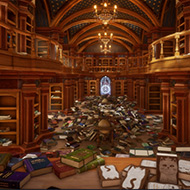
 You drag the cursor across a bloodstained study floor in Librarian: Tidy Up The Arcane Library!, and a torn photograph slides loose from under a chair leg the game never marked for you. Nothing glows, nothing pulses, and nothing announces where to look next. The case only moves once you have actually noticed something yourself, which is the whole point of sitting down with this game in the first place.
The case opens on Richard Green, described in the file only as a veteran, a father, and a husband, found dead in a room that refuses to explain itself. You are cast as a troubled detective carrying a cursed artifact, the Death Sketchbook, and the early twentieth century setting means there are no digital records to lean on: everything you learn comes from paper, objects, and what you can physically reconstruct by hand. Richard Green’s study is dressed with the kind of clutter a real study would have, and the game trusts you to separate the objects that matter from the ones that are just furniture.
Movement through the scene works through a point-and-click virtual hand rather than a fixed cursor, so searching a drawer or turning over a photograph feels like a physical action instead of a menu selection. Zooming into a torn letter or a stained rope is how you find the traces the case depends on, and the game gives you no checklist for which ones matter yet. Completionist players tend to re-examine every drawer twice before moving on, since Richard Green’s study rewards that kind of over-checking more than speed.
What makes Richard Green’s death land is that the objects you’re examining were clearly staged with a specific story in mind, and the game never spells that story out directly. You piece it together from a suicide note with missing words, a diary entry cut short, and a conversation fragment that only makes sense once you’ve drawn the object it refers to.
Once you’ve identified a trace worth recording, drawing is how you lock it into the case. You aren’t sketching for artistic style; you’re recreating the correct position and shape of a specific object, and the sketchbook only accepts your drawing once it roughly matches what was actually there. Draw a gun in the wrong grip position, or a rope with the wrong number of loops, and the case simply doesn’t move forward. Players coming from hidden-object games will recognize the search rhythm immediately, even though the drawing step is unique to this case.
The objects worth reconstructing this way include:
That last category is why the memory side of the case matters as much as the drawing side. Details you notice early in a scene, a name mentioned once, a date on a letter, resurface later as blanks you’re expected to fill without being reminded where you first saw them.
Most new players lose time hunting for a highlighted hotspot that doesn’t exist. Librarian: Tidy Up The Arcane Library! rewards deliberately re-examining objects you’ve already looked at once, since the sketchbook won’t accept a drawing until you’ve actually registered the detail it depends on. Newcomers to point-and-click investigation games are the ones most likely to hit a stall here, since they’re still learning to back out and re-attempt a trace rather than redraw it in place.
One snag players discuss directly: after scanning the words Richard Green and moving into the gun-drawing step, the case can stall and refuse to advance even when the sketch looks correct. It’s the kind of imperfect moment that comes up in comment threads more than once, and knowing it exists ahead of time saves the frustration of assuming you’ve simply drawn it wrong.
Players who finish a full run, roughly half an hour once you’re not restarting for a missed detail, tend to agree the closing pages recontextualize scenes from earlier in ways the case never announces up front.
A first pass through the opening content runs five to ten minutes, but the full case stretches closer to half an hour once you account for re-reading notes and redrawing traces that didn’t register the first time. Players who already know what the sketchbook expects from a drawing tend to land toward the shorter end.
The most commonly reported snag happens right after scanning Richard Green’s name and moving into the weapon-drawing step, where the case can refuse to progress even with a correct-looking sketch. Backing out and re-attempting the trace, rather than redrawing it repeatedly in place, is what usually clears it.
No artistic ability is required, since the sketchbook is only checking rough position and shape against the object it’s expecting, not linework or proportion. Anyone who can trace an outline with a mouse can clear every drawing step the case throws at them.
Librarian: Tidy Up The Arcane Library! stays memorable less for its length than for how it treats the Death Sketchbook itself, the cursed notebook you never asked for, as the only tool standing between you and understanding what actually happened to Richard Green.







There are no reviews yet. Be the first one to write one.